I’m chatting with Brisbane-based comics writer Henry Goeldner. His warrior fantasy brawl Killer-of-Men depicts a world rife with ego, vice and caprice. Hey, that world seems oddly familiar... We chat about his influences, and his approaches to collaboration, and self-publishing indie comics.
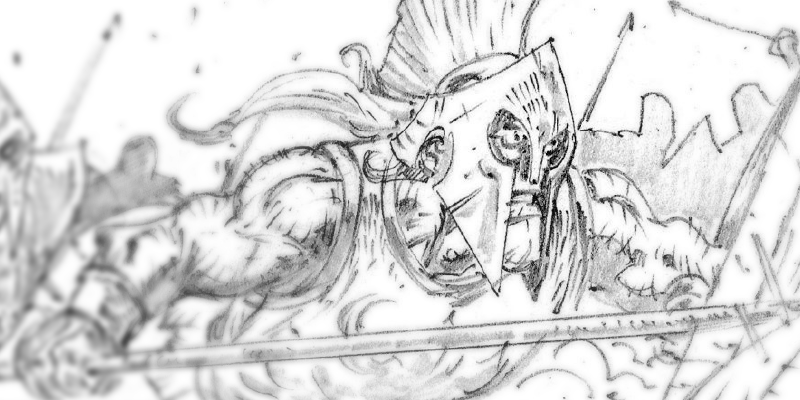
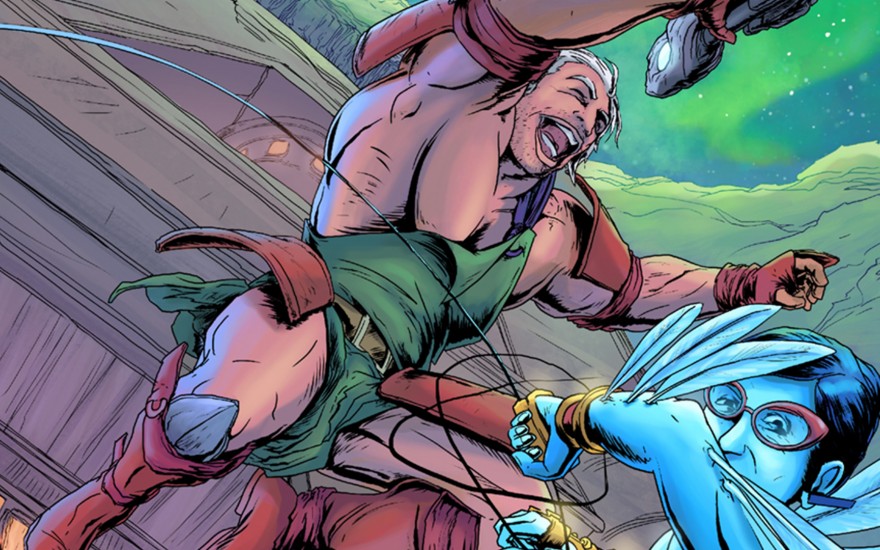
Matej Stic and I originally worked on Killer-of-Men for an anthology book. I liked the characters and concepts, and have always enjoyed Greek history and mythology. Even though it draws on the themes, societies, and imagery of Ancient Greece, ultimately it exists in its own time and place.
Killer-of-Men is about how vanity, arrogance, and pride drives people to do cruel and petty things - ultimately leading to a bad situation for everyone. It’s also Greek-style warriors beating the snot out of each other.
They’re the root of most of our problems, both as individuals and as a collective. The need to save face, to forward our own interests at the expense of others, and the deep-seated belief in our own worldview against any outside evidence causes nothing but harm.
The big-picture cruelties of life are just the everyday cruelties on a rampage.
The big-picture cruelties of life are just the everyday cruelties on a rampage. This lack of concern for each other’s well-being - the basic lack of compassion - leads to larger forms of dehumansation. We don’t want to consider the humanity of others if it interferes with the comfort of our own existence.
Refusing to recognise each other’s basic humanity makes it easy to do whatever we want, and that’s a hard thing to shake.
Compassion and empathy are the only answers I have.
Compassion is the ability to really put yourself in the shoes of another human being - to connect with them in a meaningful and loving manner. I don’t know how to fix the world, but we can start by focusing on the smaller picture.
A lot of what is wrong in how we relate to each other is a failure in compassion and empathy. We want to feel like we have a certainty about ourselves... and empathy shakes up that certainty. It makes us examine ourselves and our own behaviour, and that’s not an easy thing to do. It’s something I personally fail at more times than I’d like to admit.
In many ways the problems of modern society are inherited from Ancient Greece. Its philosophy and mythology underpin western civilization. By exploring the themes of Greek mythology and society, we’re touching on themes that are still relevant to the modern day, and not always in obvious ways.
We were drawn to Marvel’s old Savage Sword of Conan comics. That black-and-white bone-crunching action appealed to me and Matej.
My dad used to have these old black and white comics, like The Phantom and Conan and cowboy and war stories. My brothers and I would go through them on lazy weekends when we were stuck at his place. I really liked the Conan stuff. It had an energy - dark and mysterious and exciting. I barely understood what was going on, which was alluring in its own way. It was a mystery I wanted to figure out.
It had an energy - dark and mysterious and exciting
My favourite Conan story is called “The Tower and the Elephant”, by Roy Thomas, Sal Buscema, and Barry Windsor Smith.
The story itself is a rip-roaring adventure, but the climax isn’t what you’d expect. Conan finds “the elephant” in the tower - it’s a majestic, dying alien, and it’s been held captive and tortured by the villain. As he comes before this great, dying creature, Conan treats it with a quiet respect and compassion - not things you’d expect from a barbarian story.
The way the story turns into something unexpected, not just in plot but in the character of Conan himself - that really caught my attention. It revealed a new depth to the character and the imagination of Bob Howard.
As a kid, it really blew my mind.
The first questions is “who can I afford?” and the second is “who is available?”
I’ve been lucky to have the friendship of talented people willing to work for practically nothing. I’ve also had the misfortune of losing my budget on the everyday emergencies of real life.
What initially attracts me to an artist is some element of their work that speaks to me on a personal level. What seals it is a shared mind-set or creative energy - that hard to identify ‘spark’ that lets you know this is someone you can make something with.
It all starts with the pitch and pre-production. We talk about what we want out of the book, both as story and artistically.
I wouldn’t say this has directly impacted the way I write my scripts - every script starts the same way: page 1, panel 1. However, the story and characters can morph around the thoughts and feelings of the artist. I try to keep elements flexible. Even when the original ideas are mine, the act of collaboration requires a flexibility of vision.
I tell them, either in the script or after seeing the thumbs/lines. It's all about open and clear lines of communication. It’s never a case of firing off a script and then sitting on your hands.
Comic book making is a conversation at every stage, and you have to be honest and open with each other through the whole process. A script should be clear in what you see/want, but also leave room for the artist to move in, and even throw it out for something better.
Mostly the lack of a practical alternative. Without the backing of a publisher to print and put a book in stores, it leads to a big question about return on investment.
The decision came partially from seeing creators like J.D. Faith (absurdly talented creator of Junkyard Lambs) have some success on the pay-what-you-want scheme.
It’s also about giving people an option. If you're broke and can't afford comics, feel free to read for nothing or very little. I've been broke and unable to do the right thing by comic creators. With that in mind, I want readers to have a guilt-free way to read a good book. And if they like issue 1, maybe they'll put some cash down for issue 2.
Have money. The dollar bill is all that matters for getting a book made. Printers aren’t going to take an IOU, and collaborators are owed a page rate.
Figure out your elevator pitch, a two sentence description that sells the message of your book. This is what you’ll be using at a convention or when you’re talking to a retailer or to anyone you want to buy your book. Make it punchy and interesting.
And remember that you’re part of a community, so carry yourself in a respectful way. Don’t just be a salesman and hock your book at the slightest sign of interest. Particularly on social media people are looking for a genuine interaction. If they feel you’re just a marketer looking to sell something, it’ll turn them off.
Also: never inbox people a link to your book without being asked first. Everyone hates that, and people will hate you for doing it.
I’ve been following Berserk (Kentaro Miura) since I was 14, and Vinland Saga (Makoto Yukimura) for nearly as long. Golden Kamuy (Satoru Noda) and Dungeon Meshi (Ryoko Kui) are two newer books that are shaping up to be the best of this generation of action/adventure titles. My first manga love will always be Fullmetal Alchemist (Hiromu Arakawa).
The Cowboy Song - Thin Lizzy
Dazed and Confused - Led Zeppelin
Harvest - Nobuo Uematsu
Get off My Back - Public Enemy
Blood on the World’s Hands - Iron Maiden
You can find Henry on Twitter at @HenryGoeldner.
Available on Gumroad: